
NexSim
By Nexus OFS – a 3D oilfield your operators can walk into, work on, and get it wrong in, before they ever set foot on the real one.
What it is
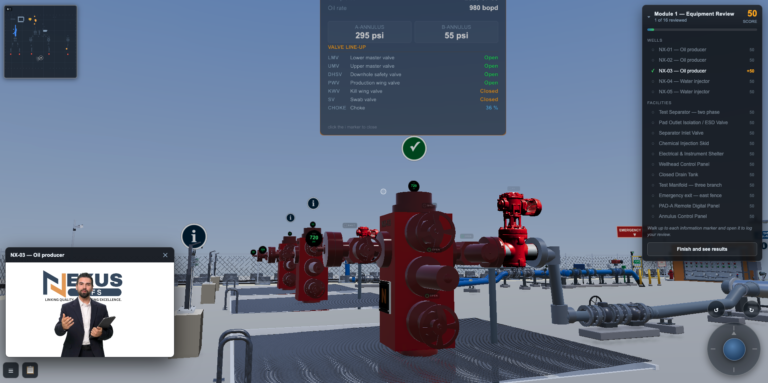
NexSim is a full oil and gas wellsite, rebuilt in 3D and running in a browser. Not a video, not a slideshow — a place. Trainees walk it in first person, turn the valves by hand, read the gauges, open the control panel and work to a written procedure, exactly as they would on shift.
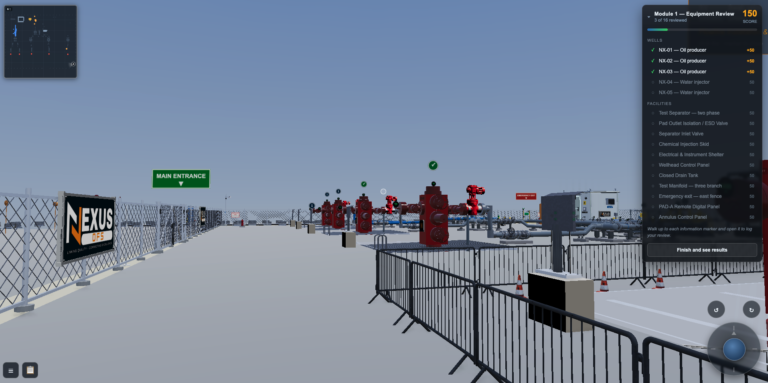
The pad in NexSim today is a five-well production site: three oil producers, two water injectors, a test separator, a manifold, a chemical injection skid and an electrical and instrumentation shelter. Every wellhead has its own tree, every tree has its own valves, and every valve behaves the way that type of valve behaves.
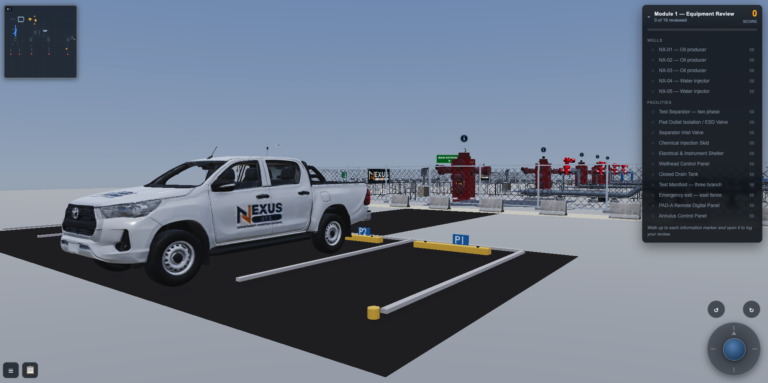
Modelled to work like the real thing, not just to look like it.
Every item on the pad carries the mechanical behaviour of the equipment it represents. A gate valve takes eighteen turns of the handwheel and travels for as long as a real one takes to stroke — genuinely part-open while it moves, with the process responding to that. A choke holds a position rather than a state. An actuated valve has no handwheel at all and will not move in the field, because that type is worked from the wellhead control panel with the control room’s permission. Gauges read what the process is doing, not a number written into a script.
None of this is explained to the trainee. They meet it — and an operator who has met it in NexSim already knows how the equipment behaves under their hands before they ever touch the real thing.
Every action has a consequence
NexSim is not a click-through. Underneath the 3D there is a process model, and it does what the plant would do.
Recover it there and the lesson costs a restart. Miss it, override it, or keep pushing, and NexSim carries the sequence the whole way — because that is exactly where the lesson lives.
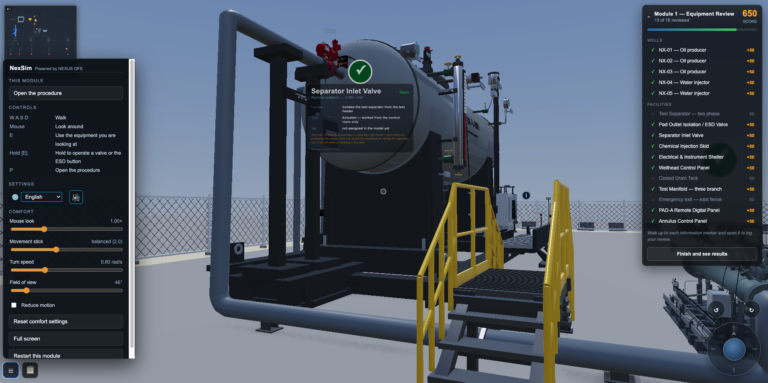
Valves take real time to move: a number of turns on a handwheel, a stroke measured in seconds, and a position that is genuinely somewhere between open and shut while it travels. The line-up decides where the fluid goes. Pressures and levels follow from what the trainee actually did, not from a script deciding what should happen next.
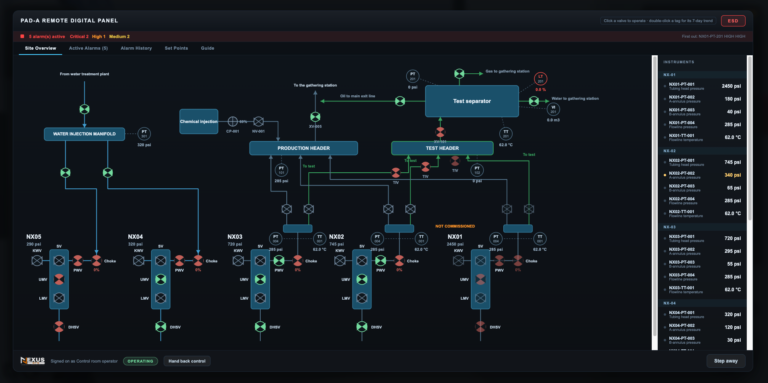
In NexSim a mistake costs points. On real life it has significant HSE and Financial implications.
That asymmetry is the entire argument for training this way. In NexSim the price of getting it wrong is a points penalty and a line in the debrief explaining what happened — an operator can make the mistake, see it develop, and make it again next week until they stop making it. The learning curve is steep precisely because the cost of being on it is nothing.
The same mistake on a live facility is an HSE event and a financial one: people exposed, production deferred, equipment damaged, an investigation opened, and a report that follows the asset for years. Nothing about the mistake changes between the two — only what it costs.
This is also what separates a simulator from a slideshow. A trainee who over-fills a separator in NexSim does not read that it was wrong — they watch it happen, hear the alarm, and have to recover it. And an operator who ignores that alarm long enough sees where it ends: escalation to loss of containment, to release, to a major accident, played out on the site they work on.
Almost nobody in this industry has seen a major accident develop. Everybody is trained on what to do about one. NexSim closes that gap — it lets an operator watch a catastrophic sequence build out of an ordinary decision they themselves made, which is the only way that particular lesson is ever really learned.
An instructor who is always beside you
Walk up to the separator in Module 1 and click it. A card opens naming the vessel and its tag, and an instructor video plays alongside it, explaining what that equipment does and why it is there.
This happens at every piece of equipment on the pad — the wells, the manifold, the separator, the chemical injection skid, the control panel, the shelter. The trainee is not reading a manual about a separator; they are standing in front of one, looking at it, while somebody explains it to them in their own language.
That combination is what makes the induction work. Text tells you a fact. A diagram shows you a shape. Standing at the equipment, seeing it from every angle, hearing what it does and then operating it yourself engages several channels at once — and what is learned that way is retained in a way that a classroom slide never manages. It is guided, self-paced, and repeatable as many times as the trainee wants, without occupying an instructor for a single minute of it.
Customization to your field
NexSim is built to be rebuilt. NEXUS OFS can replace the pad with your layout — your wells, your tags, your equipment, your line-up, your procedures.
Once it matches your site, it stops being a training environment and becomes a digital twin: the same wells with the same names, the same valves in the same places, the same alarms at the same set points. An operator who learns their way around in NexSim already knows their way around your pad. A procedure rehearsed in NexSim is the procedure they will follow.
That is the difference between generic training and training that transfers. Somebody who has walked your site a dozen times in NexSim arrives on their first shift knowing where the emergency exit is.
Our team builds it with yours. We work directly with your operations and technical people — from your layouts, P&IDs, tag registers and existing written procedures — so that what ends up in NexSim is your facility as it actually runs, not an approximation of it. Your operating procedures become the procedures inside the simulator, step for step.
Not just wellpads. Whatever you operate.
The wellsite is where NexSim started, and the same approach applies across the value chain. Upstream — wellheads, manifolds, separation, injection, gathering. Midstream — pipelines and pump stations, compression, metering, storage and terminals. Downstream — process units, utilities and the control rooms that run them.
If your people walk it, operate it and follow procedures on it, it can be built as a digital twin and trained on.
Current programme
Seven modules, taken in order. Each one unlocks when the last is passed.
1
Site Induction
Report in, complete the HSE brief and permit to work, then walk the pad. Approach any piece of equipment and an instructor video opens beside it, explaining what it is and how it works — in the trainee’s own language.
2
Site Data Collection and Visual Inspection
An operator round. Read the instruments, write the readings on a logsheet, count the standing alarms at the panel and report any visual leak.
3
Oil Well Start-Up
Line up the tree and the flowline, bring a producer online safely, and confirm it is stable.
4
Water Injection Well Start-Up
Line up and start an injector, set the rate, and confirm injection into the formation.
5
Field Emergency Shutdown and Restart
Trip the facility, make it safe, then bring it back in the correct order.
6
Well Integrity Maintenance
Wellhead and Tree valves integrity testing activities and DHSV (Downhole Safety Valve) testing activities as per international standards to ensure well barriers safety.
7
Anomaly Troubleshooting
Read the alarms and the trends, find what is actually wrong, and act on the cause rather than the symptom.
Certification at the end
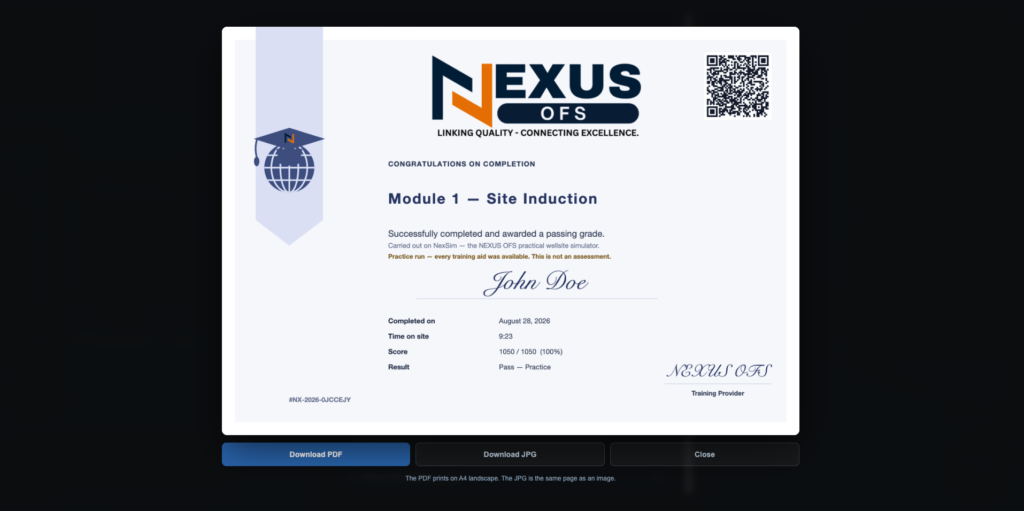
A trainee who passes an assessed module receives a certificate — dated, named, scores and tied to the run that earned it.
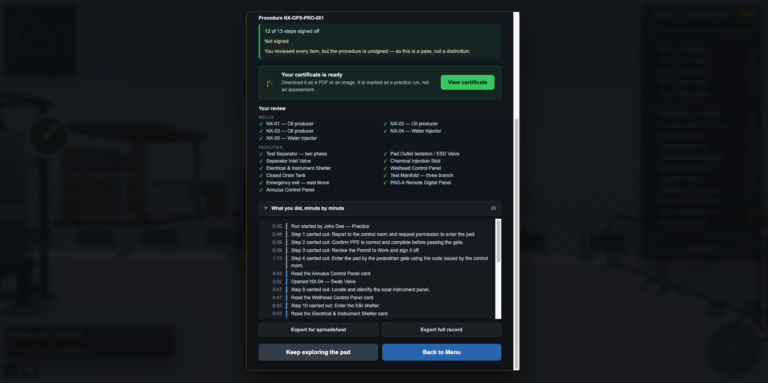
The certificate is backed by evidence rather than attendance: the session record behind it shows exactly what the operator did to earn it.
For Operations and Asset Managers
Fewer incidents, faster competence
- Mistakes happen here instead of there. Every wrong line-up, missed step and false sign-off lands in a simulator where the cost is a restart — not lost production, not a damaged vessel, not an incident report.
- Shorter time to competent. Operators arrive already knowing the layout, the tags and the procedures, so supervised hours are spent building judgement rather than pointing at equipment.
- Procedural discipline, measured. NexSim reports steps signed off without being carried out — the precursor behaviour behind a large share of process safety incidents, and one you normally only discover after something has gone wrong.
- Emergency response rehearsed safely. Shutdown and restart can be practised as often as it takes, on a live-behaving facility, without ever taking the real one down.
- Major accident scenarios, survivable. Escalation sequences your crews would otherwise only meet in a case study can be run on your own facility — and run again — so the recognition is built before it is needed.
- Weaknesses visible across a cohort. When twelve of thirty trainees skip the same check, that is a procedure problem or a training problem — and it is on the report rather than in an incident investigation.
For HR and Learning & Development
Competence you can evidence
- Proof, not attendance. A signed attendance sheet says somebody was in the room. A NexSim record says what they did, in what order, and what they got wrong — the difference between a training file and an auditable one.
- Onboarding that starts before day one. New hires learn the site, the equipment and the procedures before they are mobilised, so their first day on the pad is supervision rather than orientation.
- The same standard for everyone. Every trainee gets the identical site, the identical procedure and the identical marking — across crews, contractors and countries.
- In their own language. An operator is assessed in the language they will actually work in, which removes language from the list of reasons somebody underperformed.
- Refresher without rescheduling. Re-running a module costs an hour at a desk, not a rotation and a flight.
Where it runs
One simulator, three ways in. No installation, no specialist hardware required to begin.
Computer
Opens in a browser on any modern laptop or desktop. Walk with the keyboard, look with the mouse, work equipment by hand. Nothing to install.
VR
Step inside the pad at full scale in a headset. Reach for the handwheel, look up at the tree, judge the distances the way you will on site — the closest thing to being there.
Bring NexSim to your field
NEXUS OFS can rebuild NexSim around your own site — upstream, midstream or downstream — with your equipment, your tags and your procedures, and deliver it as a digital twin your operators train on, are assessed in, and are certified from, before they ever walk the real facility.
Talk to us about a demonstration, or about what it would take to model your field
info@nexusofs.com